
It is quite ironic when a team’s most enduring mode of existence is instability. As cricketing action moves to the British Isles for a month for the Women’s T20 World Cup, the narrative around the Indian outfit challenging for the title continues to carry a big question mark in bold red next to its name.
The 12-team tournament has India placed in a ‘group of death’ alongside Australia, South Africa, Bangladesh, and Pakistan. Going by form and keeping the possibilities of thrillers and upsets out of the equation, there is likely to be an upset given the three-way fight for the top two spots in this group.
In the 2024 edition held in the UAE, India went in all guns blazing, only to suffer a morale-crushing defeat to New Zealand in the opening game, which set the wheels in motion for an eventual group-stage exit. The side didn’t need opponents to chip away at confidence. Unresolved line-up issues, injuries, and enduring structural and tactical flaws reduced a campaign that began with much promise to a tame whimper.
ALSO READ | Most runs, most wickets, top score and all other records you should know
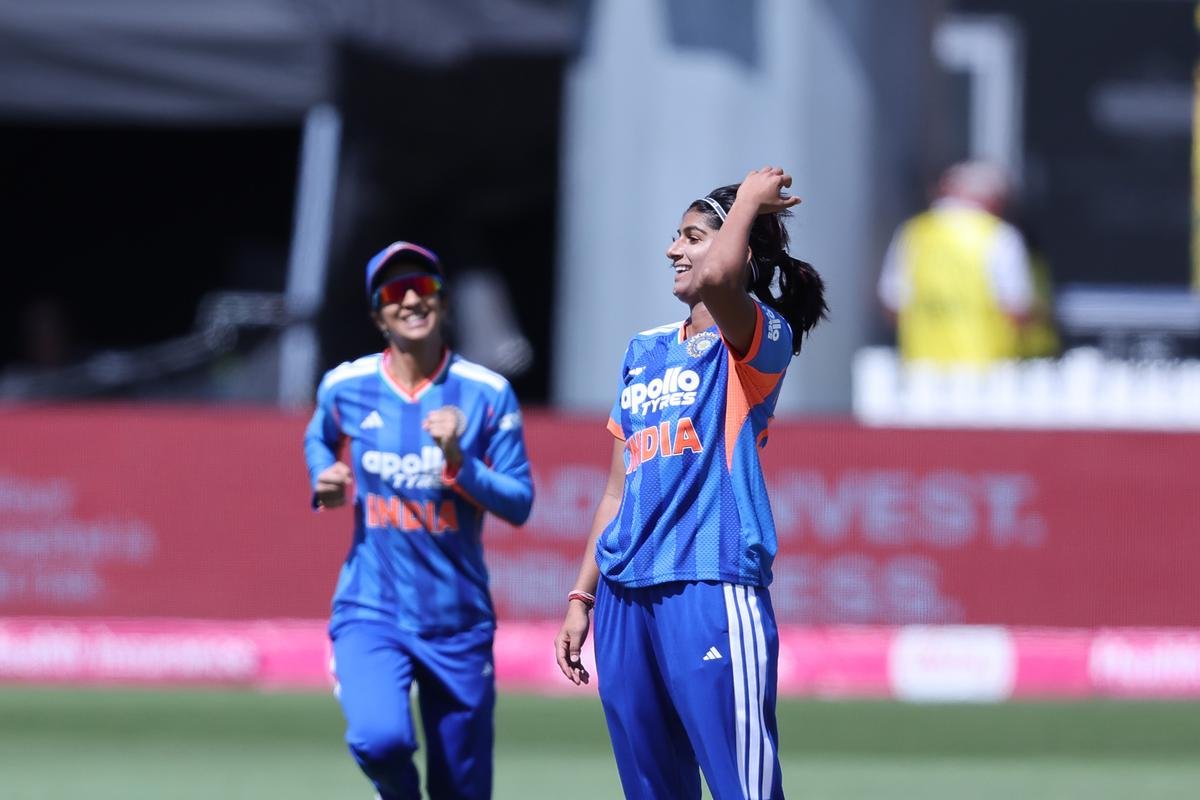
The Indian T20 side of 2026 is, one would expect, a wiser setup. It has gone through the highs of an ODI world triumph last year, which, too, didn’t come easily, courtesy a gruelling soul-searching exercise where three defeats to the three biggest sides nearly threatened to push India out of contention in a home World Cup, before a remarkable resurgence and wave of belief carried it to the podium. It is also an outfit that is reaping the benefits of four editions of the Women’s Premier League, both in talent acquisition and exposure. Sree Charani, Kranti Gaud and Nandni Sharma are direct WPL-highlighted selections in the last two years. Bharti Fulmali finds herself back in the Indian setup after seven years, and Radha Yadav and Arundhati Reddy have wriggled their way into national reckoning thanks to commendable WPL stints alongside their domestic grind.

Nandni Sharma has been an interesting acquisition for India, a talent blooded in from the Women’s Premier League this season.
| Photo Credit:
X/BCCI Women

Nandni Sharma has been an interesting acquisition for India, a talent blooded in from the Women’s Premier League this season.
| Photo Credit:
X/BCCI Women
Old problems, new year
And yet, the whole is not exactly greater than the sum of its parts. The bowling reinforcements hogged the limelight, particularly with India’s pace all-rounder pool hampered by injuries. Renuka Singh didn’t feature in India’s preparatory series against England, either. This conversation, though, has allowed mediocre batting performances and conversations around it to run on autopilot.
The Amol Muzumdar-led think tank is yet to find its perfect middle-order combination. Ahead of 2024, India’s musical chairs for the no.3 position invited several auditionees, Jemimah Rodrigues, Dayalan Hemalatha, Sajeevan Sajana, skipper Harmanpreet Kaur herself, and even Richa Ghosh were tried out there. Record and, perhaps more importantly, logic would mandate that slot go to Jemimah; her ability to grind out runs and keep the scoreboard ticking is more valuable in the face of a middle-phase crawl than at the end when the ask is a big finish. It’s a slot she thrives in, evidenced even in India’s 1-2 series loss to England. In the 1st T20I vs England, she scored a sublime 69 off 40 balls.
Yastika Bhatia’s return was encouraging. She scored briskly alongside Jemimah but the series exposed old patterns – sluggish running between the wickets, a tendency to slow down midway and struggle to recover. She was even retired out in the 2nd T20I.
Harmanpreet locking that no.4 slot for herself opens up a few issues for India. Allowing Yastika to come ahead and slotting herself more as a power hitter might be what India could use in testing English conditions. India did that in its loss in the series decider at Taunton, but brought Deepti Sharma above Richa Ghosh.

India’s struggles, among others, has been in the finishing department. The side is yet to nail its batting positions and Bharti Fulmali, who was brought in for this role, has not gotten in a consistent run in the playing XI.
| Photo Credit:
X/BCCI Women
India’s struggles, among others, has been in the finishing department. The side is yet to nail its batting positions and Bharti Fulmali, who was brought in for this role, has not gotten in a consistent run in the playing XI.
| Photo Credit:
X/BCCI Women
Richa, whose purple patch in 2023 gave the then newly appointed Muzumdar radical ideas about what all she could give this time, now has just two scores above 40 since the turn of the year. Her ability to strike the ball is intact, but she hasn’t been able to stick on and produce an innings of some gravitas lately. While Richa needs to find consistency, her place as India’s first-choice keeper is fixed, making it a matter of belief. Instead of pigeonholing her for a flourish at the death, allow her to come in earlier and bat deep. If that fails, a much slower Deepti and the rest follow anyway.
A second question then becomes this: What was the point of bringing back Bharti? Meant to complement Richa’s explosiveness down the order, the Vidarbha batter has yet to come good and get a long enough run to really dig into the role. In the two T20Is India lost, she didn’t make the eleven either.
A hungry field
The T20 format might be the vehicle of propagation in the women’s game, but gone are the days when teams are just happy to turn up and participate. An expanded World Cup allows for teams like the Netherlands (a women’s T20 World Cup debutant), Scotland, and Ireland to rub shoulders with the full members, many of whom are stagnating in the format. Pakistan, Bangladesh, and Sri Lanka have promising talent but rarely convert that into consistent victories, not enough to threaten the game’s on-field oligarchy. The outsiders — buoyed by a fresh European influx into the competitive pool — have, however, made some encouraging noises in the weeks leading up to the tournament.

One of the most controversial captaincy appointments in the game, all-rounder Sophie Molineux was made Australia captain, succeeding Alyssa Healy. Waiting in the wings were Tahlia McGrath, the seam-bowling all-rounder, who has deputised for Healy throughout her stint as captain. Ashleigh Garnder, one of the best spin-bowling all-rounders in the world, was another contender. Both were curiously named Molineux’s deputies ahead of the World Cup.
| Photo Credit:
Getty Images
One of the most controversial captaincy appointments in the game, all-rounder Sophie Molineux was made Australia captain, succeeding Alyssa Healy. Waiting in the wings were Tahlia McGrath, the seam-bowling all-rounder, who has deputised for Healy throughout her stint as captain. Ashleigh Garnder, one of the best spin-bowling all-rounders in the world, was another contender. Both were curiously named Molineux’s deputies ahead of the World Cup.
| Photo Credit:
Getty Images
The Netherlands and Scotland beat Bangladesh, while Ireland beat the West Indies and Pakistan in the past few weeks, giving their ambitions of registering wins at the T20 World Cup a massive shot in the arm. That said, ambitions often fall at the doors of infrastructure and sides like South Africa, Australia, India, England, and New Zealand may not be so easy to topple.
Defending champion New Zealand comes into the event after a 1-2 loss to England. With this set to be the last hurrah for the golden trio of Suzie Bates, Sophie Devine, and Lea Tahuhu, an encore of 2024 may be beyond them. It’s a transitional side still trying to define its voice in the international game, and captain and all-rounder Amelia Kerr shoulders a huge chunk of the load of carrying that megaphone.

Amelia Kerr has a tough job on hand in defending New Zealand’s Women’s T20 World Cup crown.
| Photo Credit:
Getty Images
Amelia Kerr has a tough job on hand in defending New Zealand’s Women’s T20 World Cup crown.
| Photo Credit:
Getty Images
Its trans-Tasman neighbour, Australia — the most successful side in the competition with six titles — is also emerging from the shadows of some illustrious names in its ranks. Meg Lanning’s shoes as captain are yet to be satisfactorily filled. Injury-prone but talismanic left-arm spinner Sophie Molineux has been handed the armband after Alyssa Healy’s retirement and has had her workload managed even after the elevation. Probably not the best situation to be in if the biggest question around that call is whether one’s captain will be fit enough for the entire tournament.
South Africa is the most exciting side in the tournament this time. Finalist in the last two editions of the T20 World Cup and the 2025 ODI World Cup, the Proteas are desperate for glory. That desperation drew two disillusioned veterans out of international retirement (Shabnim Ismail and Dane van Niekerk), infusing them with new purpose. A 4-1 thrashing of India in the T20I series gone by will be a confidence booster the side needs heading into the tournament. The Laura Wolvaardt-led side isn’t without its jitters with the bat, especially when the seniors in the top order falter, but it is one of the more well-rounded units across departments in this format and therefore primed to make the knockouts. Head coach Mandla Mashimbyi declared that South Africa is picturing itself at Lord’s, the venue of the final, already.
Stage fright
England, as evidenced by the series against India, is dealing with several demons, the most urgent being a batting philosophy pulled from the 2010s. The absence of Nat Sciver-Brunt has so far rendered the side rather toothless with the bat, but it is also worrying to see just how much heavy lifting the England skipper is doing in that order. Youngsters like Freya Kemp, who bring a brisk striking ability to the side, have much to teach some of the more established members higher up the order, and it will be a wrinkle coach Charlotte Edwards would want to iron out as soon as possible. That the host finds itself in a more forgiving group alongside New Zealand will come as a relief to both sides.

The last two hosts did well to hold up their end of the bargain by making the final — Australia even thrashed India to send a roaring 86,174-strong MCG into a tizzy. It remains to be seen if England will deliver this time.
| Photo Credit:
Getty Images
The last two hosts did well to hold up their end of the bargain by making the final — Australia even thrashed India to send a roaring 86,174-strong MCG into a tizzy. It remains to be seen if England will deliver this time.
| Photo Credit:
Getty Images
The England and Wales Cricket Board, much like Australia did with the 2020 edition and South Africa did in 2023, has set some ambitious audience engagement and attendance targets to galvanise the ecosystem’s priorities to include profitability alongside parity. The last two hosts did well to hold up their end of the bargain by making the final — Australia even thrashed India to send a roaring 86,174-strong MCG into a tizzy. It remains to be seen if England will deliver this time.
As for India, one might even hope for a ‘correction’ to the storyline of 2017 and an era-defining T20 triumph to complete the nation’s white-ball cabinet. An exciting English summer awaits.
Published on Jun 05, 2026