

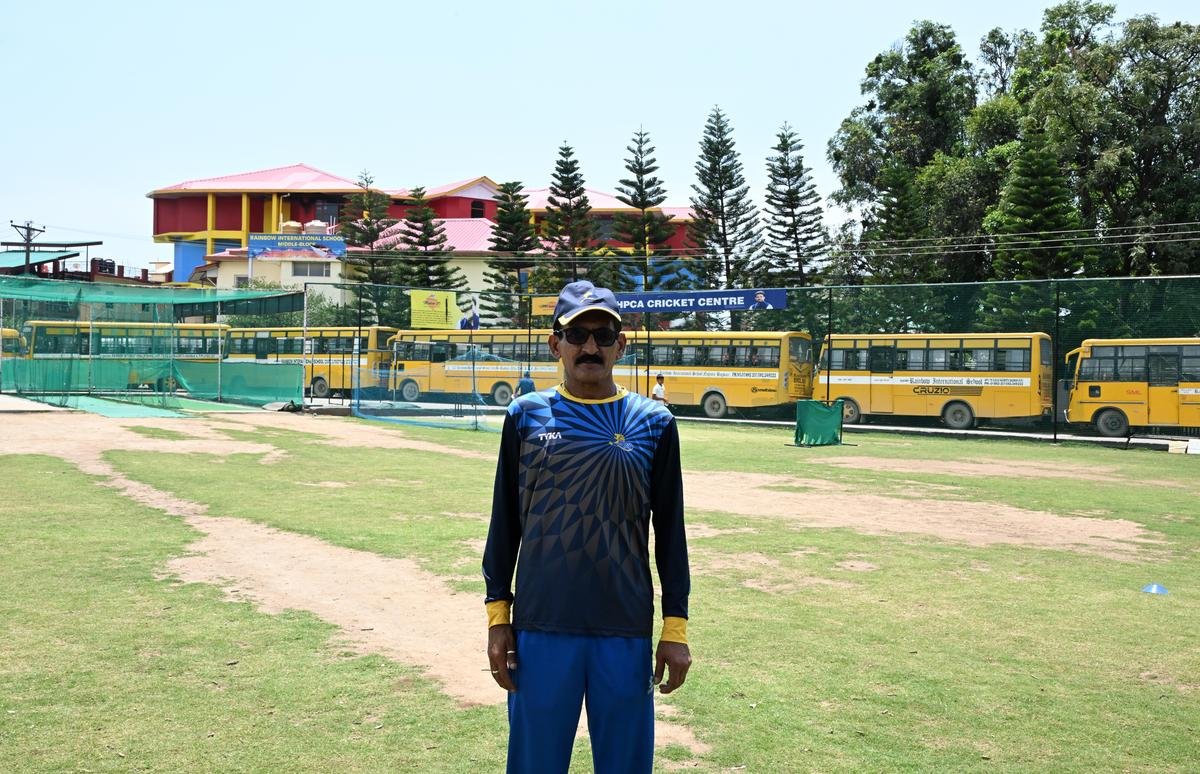
It is a quiet day at the Himachal Pradesh Cricket Association’s (HPCA) residential academy in Nagrota, 15 kilometers outside Dharamsala in Himachal Pradesh. Pawan Sen ambles across the field to explain that his students are away for their inter-zonal games. Sen is a diminutive man, but here, he stands the tallest.
He is a bit of a maverick, having spearheaded a women’s residential academy for Under-15 players since 2009. In 17 years, this academy has produced four India internationals: Sushma Verma, Harleen Deol, Renuka Singh Thakur, and Tanuja Kanwer. Two of these four are World Cup winners.
“Wherever we are in our lives, all four of us playing today, it is because of Pawan sir. He spent countless days and nights at the academy. He was the coach, the physio, the mentor, the trainer, and everything in one,” says Tanuja, who joined the academy in 2011 at her father’s insistence. Laying the foundation for what would become a feeder belt for Himachal’s women’s cricket was hardly straightforward.
“I was shocked. I joined HPCA as a coach in 2007. There was a residential academy for boys at the Dharamsala stadium, where I trained the kids. Then I received a call about this girls’ academy. The initial two-three months were awkward for me. Going to coach a women’s team was considered a demotion. It’s a shame that the girls are in the team. (Coaching a girls’ team used to be considered an embarrassment). But I also took it up as a challenge,” Sen, a former Ranji Trophy player for Himachal, recalls.
The sight of 85 girls turning up for the first set of trials in Kangra encouraged Sen. Sushma and Renuka were among those who attended the trials and also broke into the 25-member group selected as the academy’s first batch.
But making a case to parents to send their daughters away for cricket was still a challenge. “In Himachal Pradesh, people want girls to get married by 23 or 24. Whenever I tried to convince them, they said, ‘ What will you get for playing? (What will they gain from playing cricket?)’ and I had no answer,” Sen says.
Eager to prove a point, Sen once enrolled his team in an open tournament in Kangra.
“There are 30-35 teams that take part every year. I enrolled our academy’s team; all the girls were around 15 years old at that time. I was criticized from within HPCA as well. I just asked the girls not to look at who they were facing. Just play. We ended up reaching the final, and this created a huge buzz in the city. This was in 2010,” Sen says.
The gamble worked. The result convinced the association to move the academy from Kangra to the main stadium in Dharamsala. But the bigger test still lies ahead.
Himachal’s terrain and climate have ingrained a sense of resource management into everyday life. Cricket is no different.
Anything done has to be worth doing. Starting a women’s residential academy was a novel initiative, but it had to be backed by results.
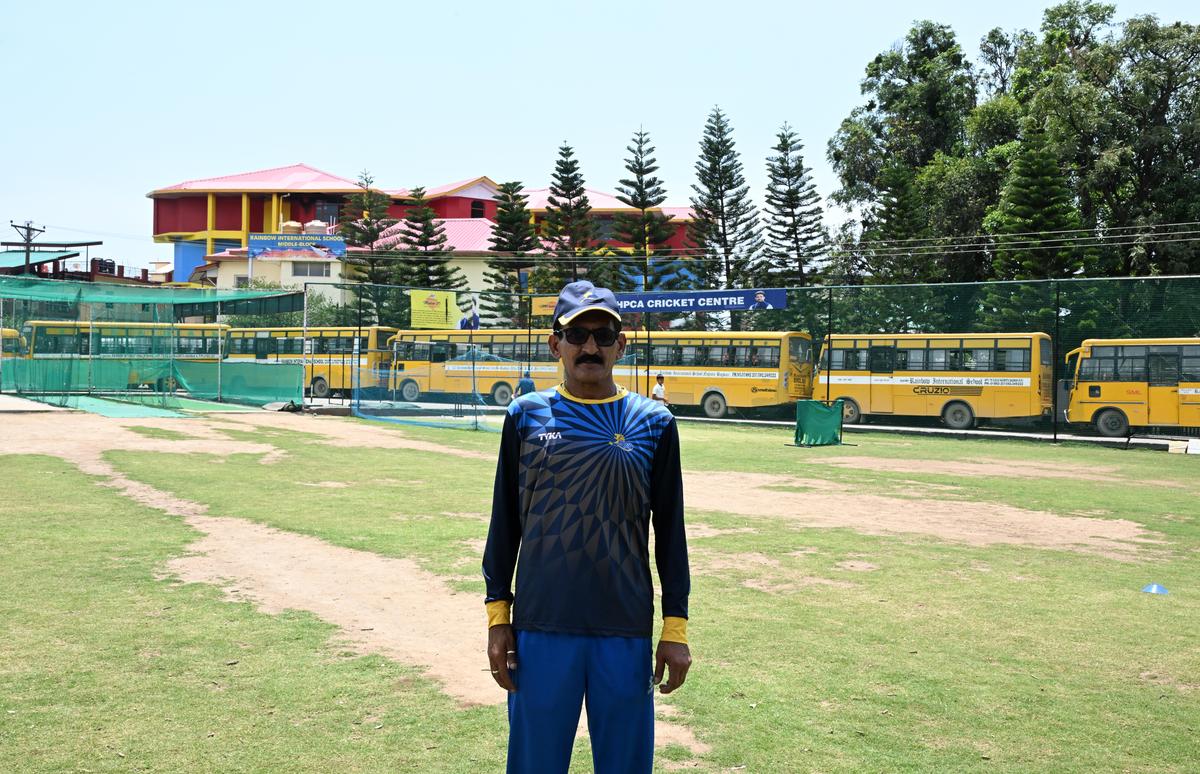
Pawan Sen, the man behind one of Indian women’s cricket’s quietest success stories. | Photo Credit: RV MOORTHY

Pawan Sen, the man behind one of Indian women’s cricket’s quietest success stories. | Photo Credit: RV MOORTHY
“There was a girls’ academy here and a boys’ academy in Una. Anurag [Thakur] ji gave us three years. He said, ‘Show me you can perform, and I will scale up this operation.’ He told the same to the boys’ academy. In the third year, I told the team that this is your final chance. If you go back home from here, then you are finished with cricket. (If you go back home now, your cricket ambitions will be over). But the girls did so well that everything changed after that,” Sen says.
What followed was the gradual expansion of a system that began to justify the faith placed in it. The academy started producing results, and the investment into women’s cricket in Himachal Pradesh gathered momentum.
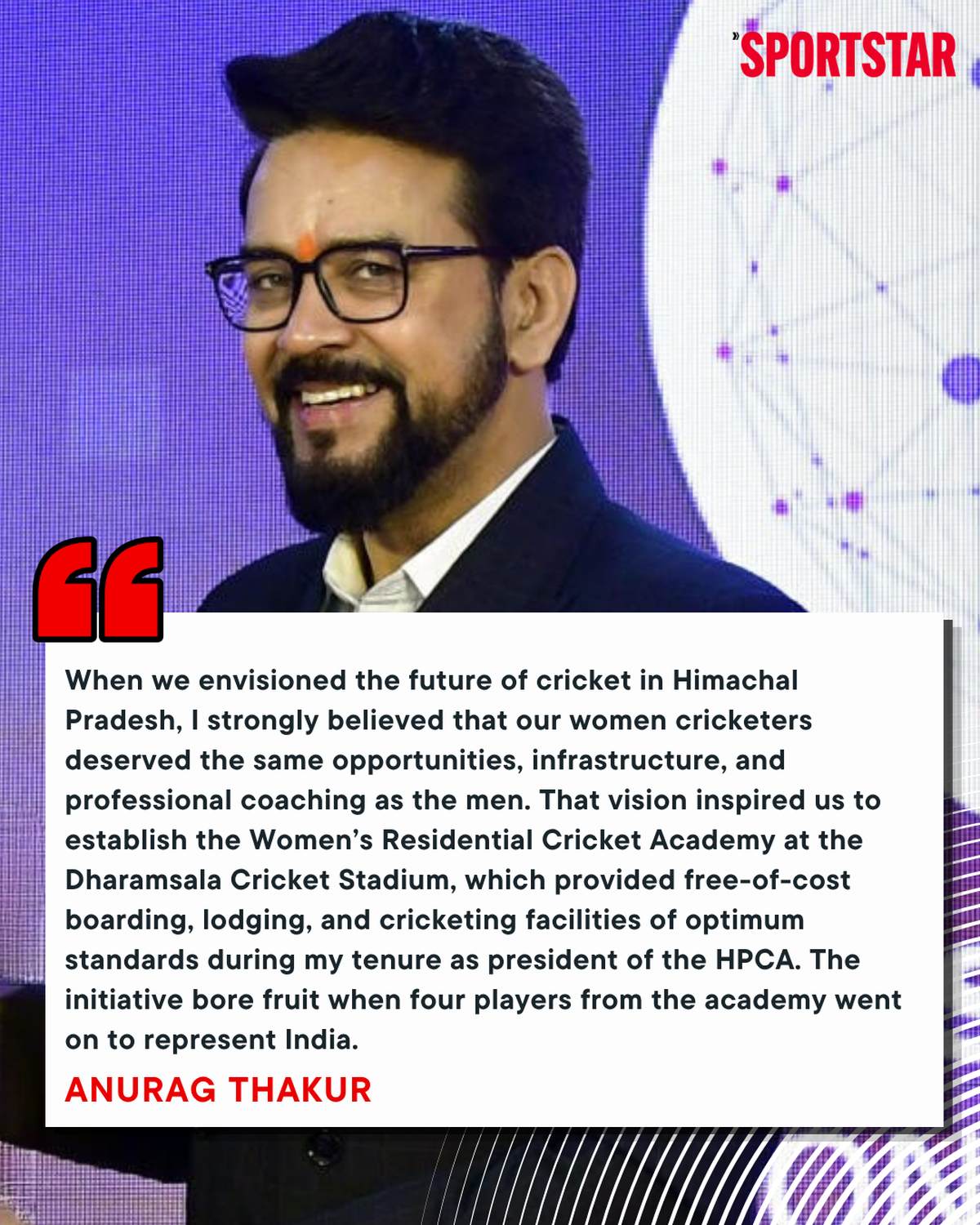
It reaffirms our belief that, with the right support and platform, talent from Himachal Pradesh can shine at the highest level of world cricket,” says Thakur, during whose tenure as BCCI president more domestic fixtures were introduced, especially at the U-19 and U-23 levels. The new domestic tournaments were also scheduled for the first time to create a proper pathway in women’s cricket.
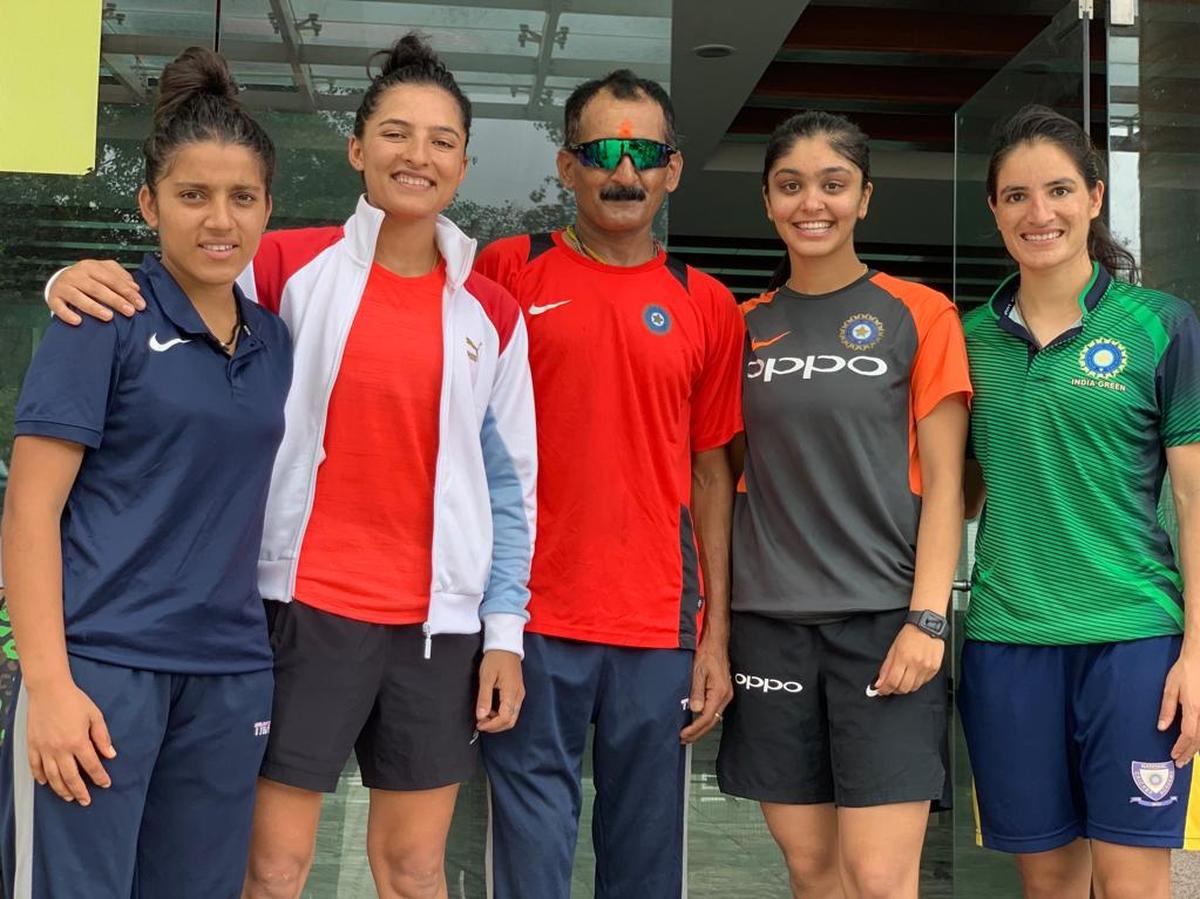
Pawan Sen with some of his most accomplished proteges, including Harleen Deol, Renuka Singh Thakur (right), Sushma Verma and Tanuja Kanwer (extreme left). | Photo Credit: Special arrangement
Pawan Sen with some of his most accomplished proteges, including Harleen Deol, Renuka Singh Thakur (right), Sushma Verma and Tanuja Kanwer (extreme left). | Photo Credit: Special arrangement
The impact of that structure soon began reflecting in results on the field as well. Sen coached the Himachal Pradesh U-19 women’s team to the North Zone final against Punjab, with almost the entire squad having trained under him in Dharamsala.
“The level of our cricket improved a lot in a short span because all of us used to practice together. If 20-25 girls practice together and then they play games together, a good bond is formed. The communication is good. So, we benefited a lot from that. Our team was very good,” Tanuja says.
Himachal lost the final, but Sen found another student who would blaze a trail to the Indian team.
“Harleen was not getting enough playing time in the Punjab team. Her parents saw how the team played in that final. They knew Sushma’s parents, who sent them to me. I initially sent them back. I said we take in just girls from Himachal Pradesh. But they were able to convince me. Harleen impressed me with her bowling too, and she joined in 2011,” Sen says.
In 2013, Sushma got a call-up to the T20 side to face Bangladesh. The following year, she was picked for the ODI team and went on to represent India at the 2017 ODI World Cup.
“Sushma played first, and that inspired all the others to dream bigger,” Sen beams.

A glimpse of the facilities at the HPCA residential academy, where Pawan Sen is shaping the next generation of women cricketers dreaming of wearing India colors one day. | Photo Credit: RV MOORTHY
A glimpse of the facilities at the HPCA residential academy, where Pawan Sen is shaping the next generation of women cricketers dreaming of wearing India colors one day. | Photo Credit: RV MOORTHY
“Before that academy started, I don’t think most girls knew that they could play cricket on such a platform. Sushma di played for India first. After that, all of us, me, Renuka, and all of us. If there were no academy, none of us would have been able to reach that stage,” Tanuja says. Sen had to wait six years before another one of his students broke into the national set-up. Harleen earned her India cap in 2019, while Renuka followed in 2021. In 2024, Tanuja became the fourth student to represent India.
“Renuka in 2019 was the second-highest wicket-taker in one-days and still did not get a call-up to India. She was so frustrated at that time. I simply gave her the example of Cheteshwar Pujara. He scored 1000 runs for two consecutive seasons to get in. I told her to repeat that performance. The same was the case with Tanuja.
“Nooshin Al Khadeer conducted a camp here. I asked her that Tanuja has been bowling so well for the last three years; what more does she need to do to get into the Indian team? She said that you’ve been patient for so long; just keep it that way for six more months; she’s about to break in. Three months later, she got the call,” Sen says.
Tanuja will tour England next month with the India-A side. Harleen will also be part of that squad. For Renuka, there is a bigger goal. She will be part of India’s T20 World Cup squad in England next month.
Back in Nagrota, Sen awaits the next month with eager anticipation. But for him, success is more than just seeing his students compete internationally. It lies in knowing that cricket has now reached Himachal’s grassroots, where girls no longer have to ask what they will gain by picking up a cricket bat.
Published on May 21, 2026