
Honesty and transparency are two very different ideals. For the longest time, India’s squads for tournament cricket were revealed in statements that left no room for the lingering questions arising from selection calls.
During Neetu David’s tenure as chief selector (which concluded in November 2025), much like in the men’s setup, the think tank began facing the press when announcing its World Cup squads. Even then, while there were honest explanations about why certain players made the cut, transparency around those who didn’t was lacking.
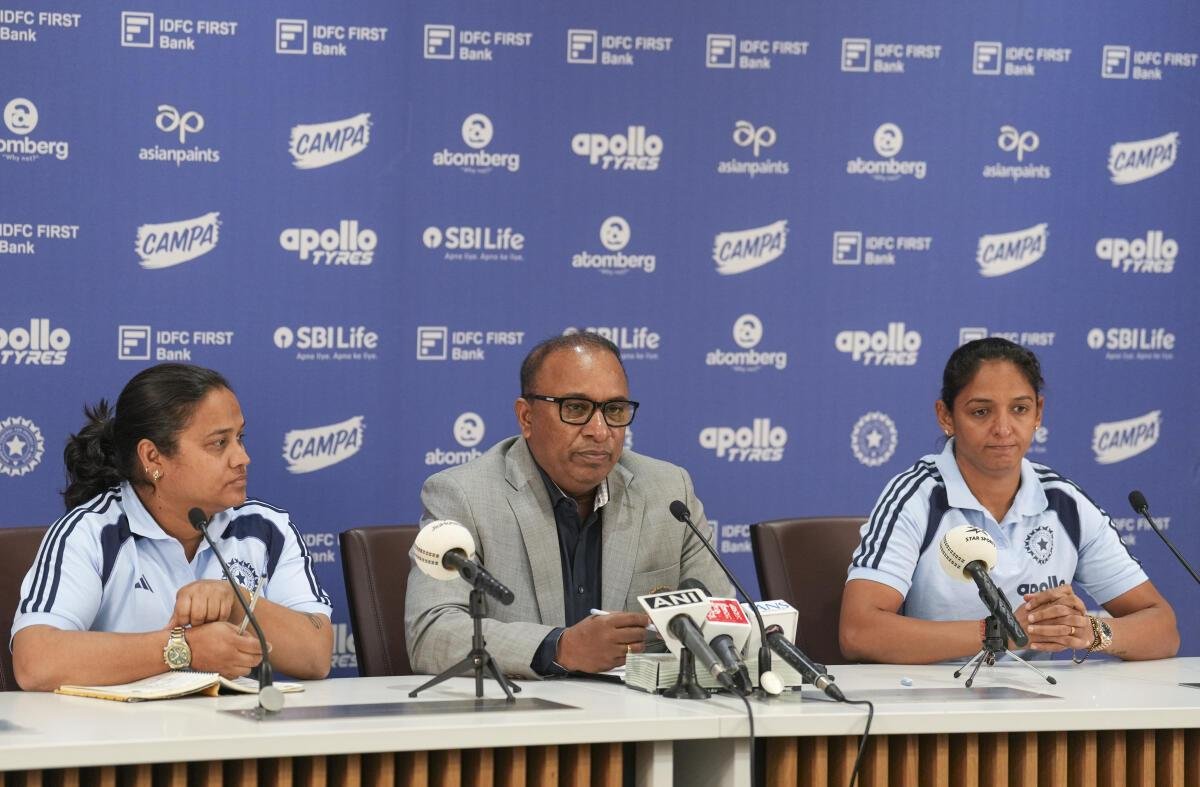
On the six-month anniversary of India’s ODI World Cup triumph, Harmanpreet Kaur sat down with new chief selector Amita Sharma and BCCI secretary Devajit Saikia to unveil the squad that will represent the nation in the T20 World Cup in England next month. A refreshing clarity marked the 20-odd-minute interaction with the press, alongside a fairly predictable lineup.
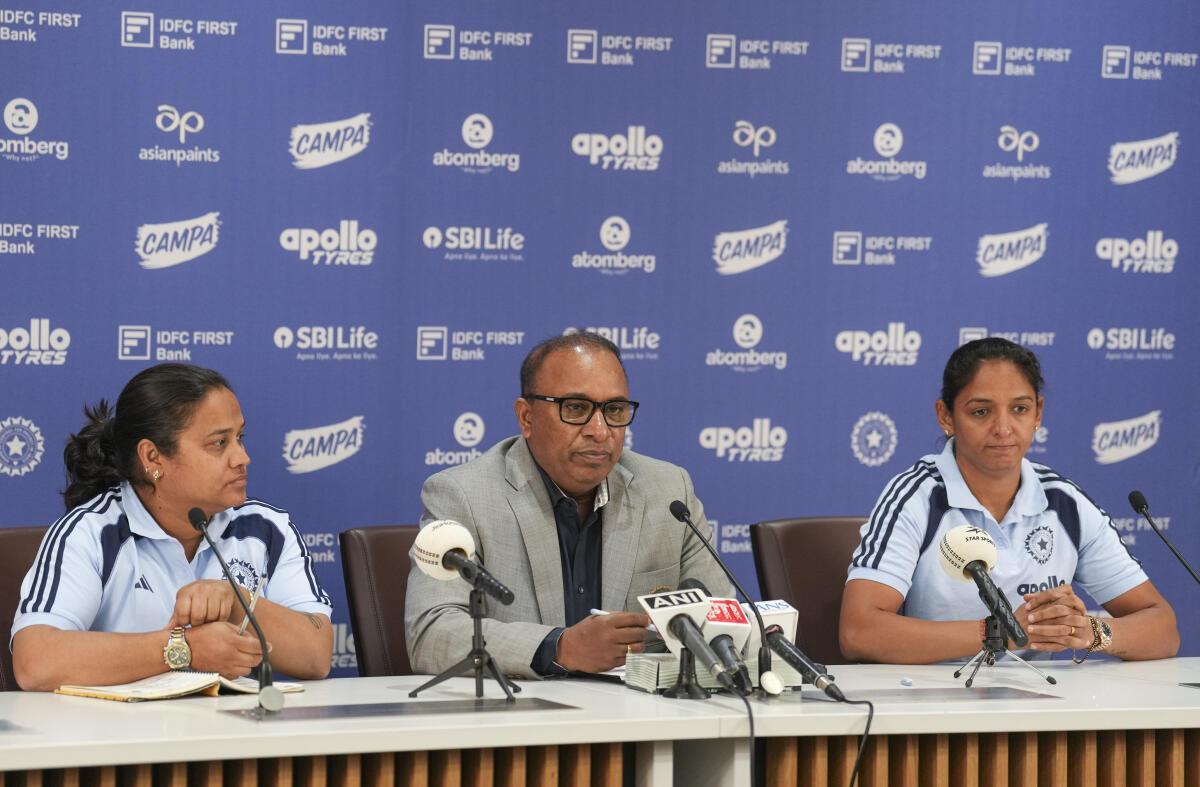
BCCI Secretary Devajit Sakia, centre, Chairperson of the selection panel Amita Sharma, left, and Indian captain Harmanpreet Kaur during a press conference. | Photo Credit: PTI

BCCI Secretary Devajit Sakia, centre, Chairperson of the selection panel Amita Sharma, left, and Indian captain Harmanpreet Kaur during a press conference. | Photo Credit: PTI
Three names dominated the headlines: uncapped pacer Nandni Sharma, the experienced Radha Yadav, and keeper-batter Yastika Bhatia, all handed a seat on the plane to England.
But what did not go unnoticed this time was the glaring hole in the pace-bowling all-rounder slot, a role the management has been trying to stabilize since WV Raman’s tenure as head coach.
Amanjot Kaur, who was part of the ODI World Cup squad, has spent most of her time out of the India setup due to injury. She is a handy lower-order batter who can muscle the ball but, more importantly, rotate strike seamlessly, something the Indian tail often struggles to do.
Bleed for speed
With Deepti Sharma’s strike rate continuing to raise concerns, and the likes of Arundhati Reddy and Shreyanka Patil yet to impose themselves with the bat as consistently as India would like, Amanjot had the leadership’s confidence. Her absence is a blow in itself, but what compounds it is her replacement, Kashvee Gautam, also falling out of contention after picking up a knee injury during the recent South Africa tour, one that now requires surgical intervention.
“In Kashvee’s case, there is a problem in her right knee, and she will have to undergo an operation. It’s a serious injury. Rest….,” Amita began to explain, before the captain interjected, “About Kashvee, the medical team will update on her exact condition. She is not available for selection.”
The Indian setup is not known for prompt medical bulletins on player injuries, particularly those involving long-term issues. One instance comes to mind: when Shubha Satheesh fractured her thumb on day two of the one-off Test against England in Navi Mumbai, a medical bulletin confirming her unavailability was released only after India had sealed victory.
The bigger concern, though, is the failure to address a clearly worrying pattern. India’s management of its pace-bowling pool has been far from ideal. Since 2023, several quicks identified through the Women’s Premier League (WPL) have rotated in and out of the side. Shabnam Shakeel, with her forceful action, has also seen a dip in pace, an issue not isolated to her.
Beyond all this lies a larger question: where is Pooja Vastrakar, the quintessential pace-bowling all-rounder who combined speed and accuracy with the ball and power with the bat, and will she return?
Fast-tracking Nandni, who emerged from WPL 2026 as the joint-highest wicket-taker with 17 scalps in 10 matches, including a hat-trick and a five-wicket haul, addresses part of that concern. The selectors have backed her all-phase bowling ability and versatility. She has even hinted on social media that she can contribute with the bat, something that may prove valuable in English conditions.
This gap has also reopened the door for Radha, part of the ODI World Cup-winning side but someone who last played a T20I in July last year, also in England. During India’s experimental phase in bilateral series, she was often reduced to a glorified fielding substitute. However, her contributions to Royal Challengers Bengaluru’s WPL triumph and her leadership of India A to victory in the Rising Stars Asia Cup have strengthened her case. With four World Cups behind her, Radha’s experience adds weight.
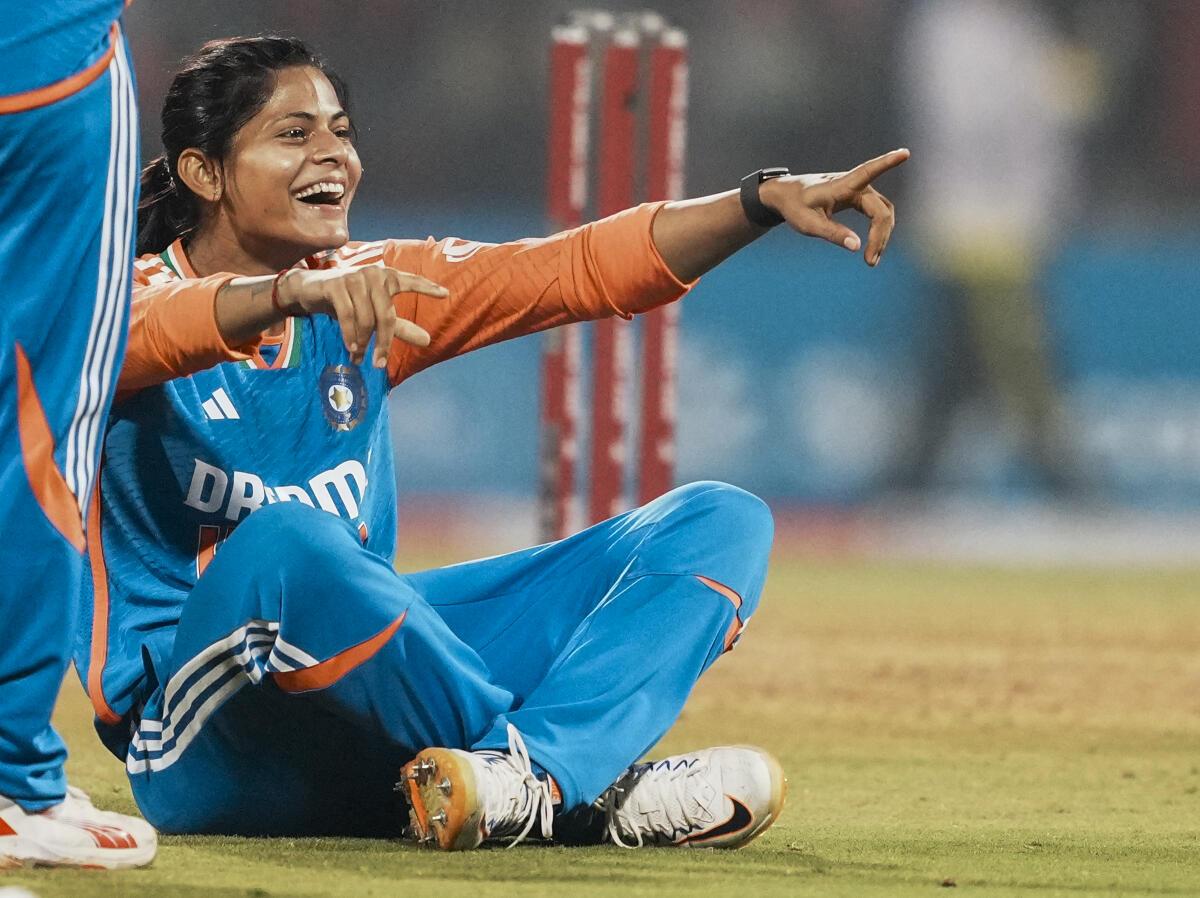
Radha was part of the ODI World Cup-winning team but last played a T20I in July last year. | Photo Credit: PTI
Radha was part of the ODI World Cup-winning team but last played a T20I in July last year. | Photo Credit: PTI
Second wind?
India’s 1-4 loss in South Africa served as a timely reminder of the instability that still lingers in the format. While Amita described the bowling performance as “disappointing”, Harmanpreet defended her unit: “In the T20 format, it’s a hard job for bowlers. Wickets were batter-friendly, but still, they tried their best. After the last T20 World Cup, we have won every T20 series. I can’t judge my players on one series.”
What went largely unnoticed was an underwhelming showing from the batters. While Harmanpreet and Shafali Verma carried the side, Smriti Mandhana struggled for consistency and was even benched for two games, where debutant Anushka Sharma replaced her. This may have been down to workload management and rotation, but given she ultimately did not make the squad, the decision remains curious.
Bharti Fulmali’s handling was equally puzzling. A player known for her finishing ability, she might have benefited from being given more responsibility. In an ideal scenario, she could have been promoted ahead of Richa to ease into the role. However, Richa’s own need for rhythm created a catch-22.
Yastika’s return is particularly poignant. A sprightly left-hander capable of dictating the tempo, the 25-year-old’s career has been repeatedly disrupted by injuries, the latest being an ACL surgery in October last year. She last played a T20I in 2024. Her selection effectively shuts the door on Uma Chetry and G. Kamalini, neither of whom established themselves as reliable alternatives to Richa.
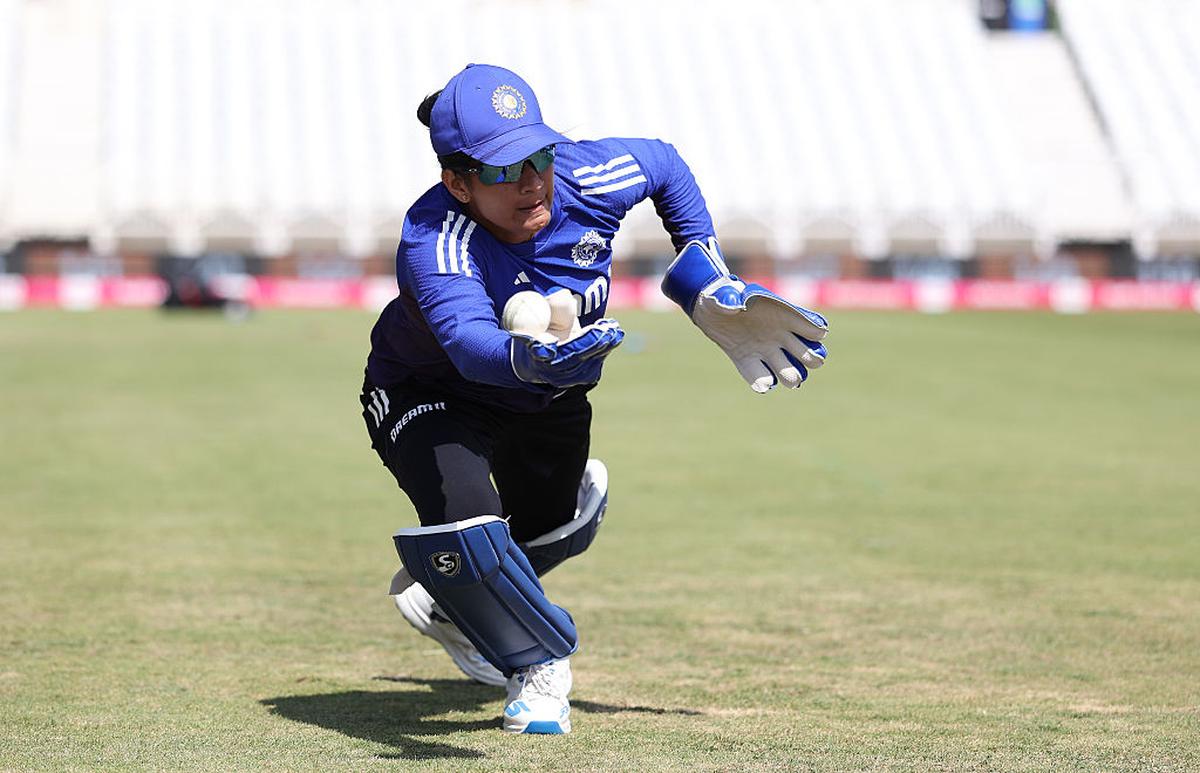
Yastika’s career has been repeatedly disrupted by injuries. | Photo Credit: Getty Images
Yastika’s career has been repeatedly disrupted by injuries. | Photo Credit: Getty Images
With a fairly settled top four, Yastika also offers a middle-order alternative to someone like Harleen Deol, who struggled to maintain the scoring rate required to hold her place in the T20 side.
India has attempted to address key gaps ahead of the 2026 showpiece, where its campaign begins against Pakistan at Edgbaston. Harmanpreet emphasized the importance of maximizing the PowerPlay in a format where teams continue to evolve.
The 2020 T20 World Cup finalist faces a challenging group featuring Australia, South Africa, Bangladesh, Pakistan, and the Netherlands. The group-stage exit in 2024 would have been sobering enough, where India’s promise failed to translate into results. This time, the setup has chosen to look beyond inexperience and back skill. The question now is whether that faith will be rewarded.
INDIA—WOMEN’S T20 WORLD CUP 2026 SQUAD
Harmanpreet Kaur (C), Smriti Mandhana (VC), Shafali Verma, Jemimah Rodrigues, Bharti Fulmali, Deepti Sharma, Richa Ghosh (WK), Sree Charani, Yastika Bhatia (WK), Nandni Sharma, Arundhati Reddy, Renuka Thakur, Kranti Gaud, Shreyanka Patil, Radha Yadav.
Published on May 05, 2026