

Age, in T20 cricket, is supposed to arrive like a warning siren. The format keeps getting younger, faster and more explosive.
Yet, in IPL 2026, some of the league’s most compelling stories are being written by players well beyond the “next big thing” bracket.
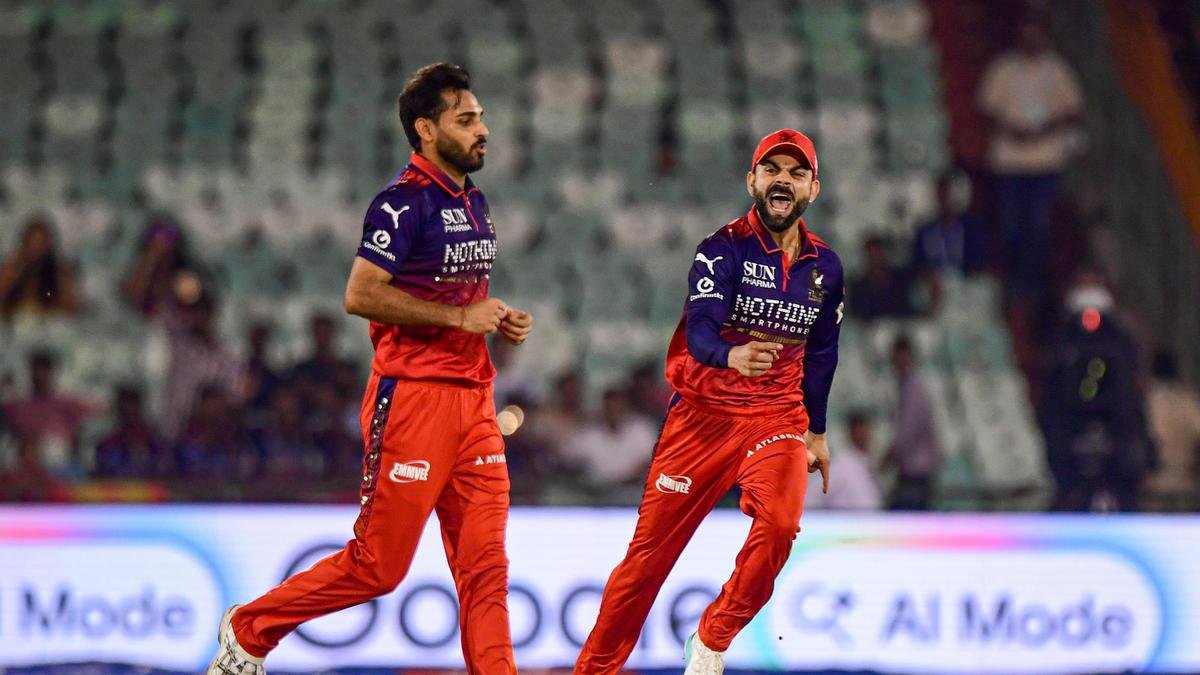
At 37, Virat Kohli remains one of the defining forces of the season. With 484 runs from 12 innings, including a century and three fifties, he sits third on the run charts with a strike rate of 165.75. At 36, Bhuvneshwar Kumar has turned the clock back with a season built not on reinvention, but precision: 22 wickets in 12 matches at an economy rate of under eight.
The easy narrative is nostalgia. The more interesting one is adaptation.
Speaking on Royal Challengers Bengaluru’s podcast, Kohli reflected on how players from an older generation are finding ways to remain relevant in a format that seems to mutate every year.
“There are different ways to achieve the same goals,” Kohli said. “Everyone has their own way of playing the game.”
For Kohli, longevity in T20 cricket is not about mirroring the next generation. It is about understanding one’s own game deeply enough to evolve without abandoning its foundations.
He pointed to examples from the past, including former South Africa captain Graeme Smith, whose methods were unconventional but relentlessly effective.
“We felt like it was very difficult for him to hit the ball through the offside with a straight bat, but through the onside he was unbeatable,” Kohli said. “People have found ways to succeed who did not have those kind of abilities or that kind of way to play the game.”
Kohli believes modern T20 cricket has evolved to such an extent that it barely resembles the format’s earlier versions.
“Today, it’s almost become a different game altogether,” he said. “Not just a different format.”
The reason, according to him, lies in the relentless intensity of the modern game.
“Every ball is an intense event,” Kohli said. “You can’t let the game drift anymore. The momentum can shift in every ball of the game.”
He compared it to elite knockout football, where a single mistake can alter the course of a contest instantly.
“It’s almost like you’re playing a high-intensity Champions League football game where one bad pass or one slip and the whole competition is done.”
Kohli acknowledged the extraordinary attacking ability of the new generation, particularly their boundary-hitting range and confidence.
“The talent is through the roof,” he said. “The youngsters coming in, the way they can hit the ball… their hand-eye coordination and the confidence they have in those abilities is outstanding.”
But while the game has changed stylistically, Kohli argued that certain fundamentals remain timeless.
“The game is set up to play between 22 yards,” he said. “There are certain technicalities of the game that will never go out of fashion. You need technique, balance, you need some kind of symmetry to play this game.”
That technical base, he believes, is what allows players like him, Bhuvneshwar and KL Rahul to adapt across eras and phases.
“When you have technical abilities in place, you can always adjust,” Kohli said. “Especially when you’re going through a tough phase, it’s easier for the guys who have technical foundation to adjust and find a way.”
No example illustrates that better this season than Bhuvneshwar.
While the IPL’s ecosystem increasingly rewards extreme pace variations and high-risk aggression, Bhuvneshwar’s success has come through old-fashioned control and relentless discipline.
“What is Bhuvi doing?” Kohli asked. “He’s not bowling banana inswingers, banana outswingers. He’s setting Test fields as well.”
Instead, Kohli said, Bhuvneshwar’s brilliance lies in his repeatability.
“He is bowling at a length that is telling the guys, ‘I am good enough to hit this length every time. It is the most difficult length to hit and I’m just going to keep hitting this length. Are you good enough to take me on or not?’”
For Kohli, that approach represents something deeper than tactical clarity.
“It’s simple stuff. It’s repetition. It’s execution. It’s uncomplicated consistency backed with tremendous belief.”
That belief, he suggested, is built over decades rather than seasons.
“He’s not someone who’s playing cricket all through the year,” Kohli said of Bhuvneshwar. “But the belief he has in his abilities comes from the work he’s done from childhood… those foundations will always hold him in good stead.”
There is an interesting tension in Kohli’s argument though. T20 cricket today unquestionably rewards innovation, freedom and power in ways older generations never had to confront. Technical orthodoxy alone is not enough anymore. Several highly accomplished “classical” players have faded precisely because the format stopped waiting for them.
Kohli, however, is not arguing against evolution. If anything, he is making the case that strong fundamentals make evolution sustainable.
“I think our strength is backing our abilities in a conventional way and finding ways to evolve our games accordingly with the demands of today’s cricket,” he said.
Published on May 16, 2026