
Financial investments in
performance advertising are clearly on the rise, with brands and agencies adopting artificial intelligence (AI)-driven marketing methods that lead to measurable gains in customer acquisition,
incremental sales and retail traffic. The latest data from the Winterberry Group explains why.
More than seven in ten respondents to a survey of more than 250 U.S. advertising and marketing
professionals saying they have increased performance marketing spend during the past three years.
This shows that something has clearly changed — with consistent investments seen across the
financial services, B2B technology, consumer packaged goods, and retail industries.
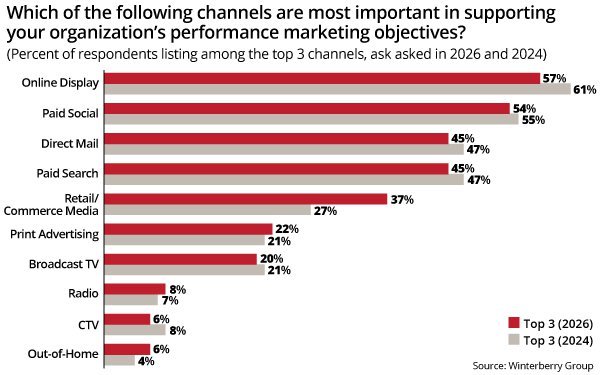
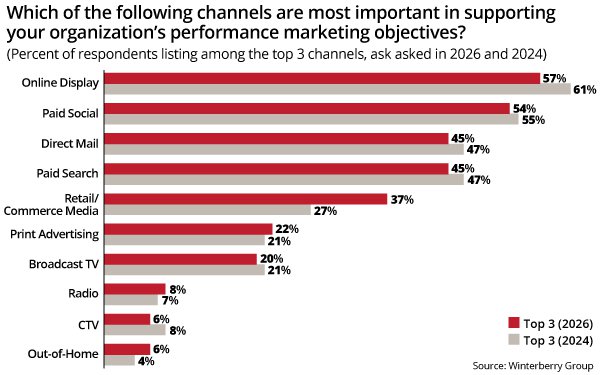
The study revealed that online display advertising ranked among the top three channels deployed with 57%,
paid social followed with 54%, direct mail at 45%, and paid search at 45%. Retail media networks also were cited by 37% of those who participated, up from 27%, in a similar survey one year ago.
advertisement
advertisement
“We now see a clear maturity curve beginning to take shape with respect to AI and the use cases it has the potential to support,” Jonathan Margulies, managing partner, Winterberry
Group, and author of the report, told MediaPost.
He added: “Brands are leaning into accumulated experiences, off-the-shelf products and custom implementations to tackle an increasingly
broad array of applications, going well beyond the workflow-and-process priorities that were at the heart of their early efforts.”
The United States Postal Service (USPS), and NaviStone,
a marketing technology company, worked with Winterberry Group to conduct the survey and release the report titled “Delivering Performance in the Era of AI: Technology, Data and New Opportunities
to Unlock Omnichannel Success.”
The most ambitious AI marketers are focused on data-related use cases, leveraging tools to help wrangle information to support cross-channel attribution,
and evolve how they build audiences from disparate datasets, Margulies explained.
“Some are beginning to cast their sights on what’s really the Holy Grail of performance marketing
like the orchestration of budgetary allocation, channel selection, creative treatments and offers across a range of paid and owned channels,” he said. “We’re not quite there yet, but
more brands are coming to see AI as the effective bridge to that kind of ‘always-on’ orchestration, and there’s growing enthusiasm for the progress that future experimentation may
unlock in the days ahead.”
There is an upside and downside to all this AI stuff. While no single issue presents a principal obstacle to continued AI evolution, the most often-cited
concerns from 38% of those participating in the study were the ability of AI to integrate with existing systems and workflows, and 36% cited the high implementation costs.
Just 25.9% of
marketers reported their AI investments to date have had little or no effect on their performance marketing metrics, while more than six in ten reported gains in marketing effectiveness like response
rates, customer acquisition, return on investment (ROI) improvements, as well as gains in efficiency like cost and cycle time savings.
Fifty-three percent of marketers in the study reported a
better understanding of the incremental impact of various marketing performance channels. Among other benefits cited, 48.2% cited adjustments to audience segmentation and targeting, while 41% cited
reallocation of spend among addressable channels.
The research also focused on the use of AI to support direct mail programs, which explains the USPS’s participation in the study, noting
the significant gains the technology is driving across a range of direct mail performance metrics.
Of those participating in the study, 42.5% cited improved targeting accuracy, while 41.6%
cited improved return on investment; 34.2% cited better orchestration with other marketing channels; and 33.3% cited improved efficiency in production, postage and operational costs as specific
benefits of their recent AI-centered initiatives.
Direct mail spending in the United States is expected to increase by 1.1% in 2026 to $36.6 billion.
During the past three
years, nearly three-fourths of marketers have increased their emphasis on performance marketing strategies, with less than 3% have decreased their focus on these strategies.
Eighty-three
percent of survey participants plan to grow their 2026 direct-mail budgets, in response to heightened demands to support chief performance marketing goals including customer acquisition, incremental
sales and retail traffic generation.
Nearly 96% said they have used AI to support direct mail performance, with 93% saying such investment delivering moderate or better value.
Overall,
more than six in ten marketers will increase their direct mail budget in 2026 by between 1% and 10%, and two in ten will increase their direct mail spend by more than 10%.